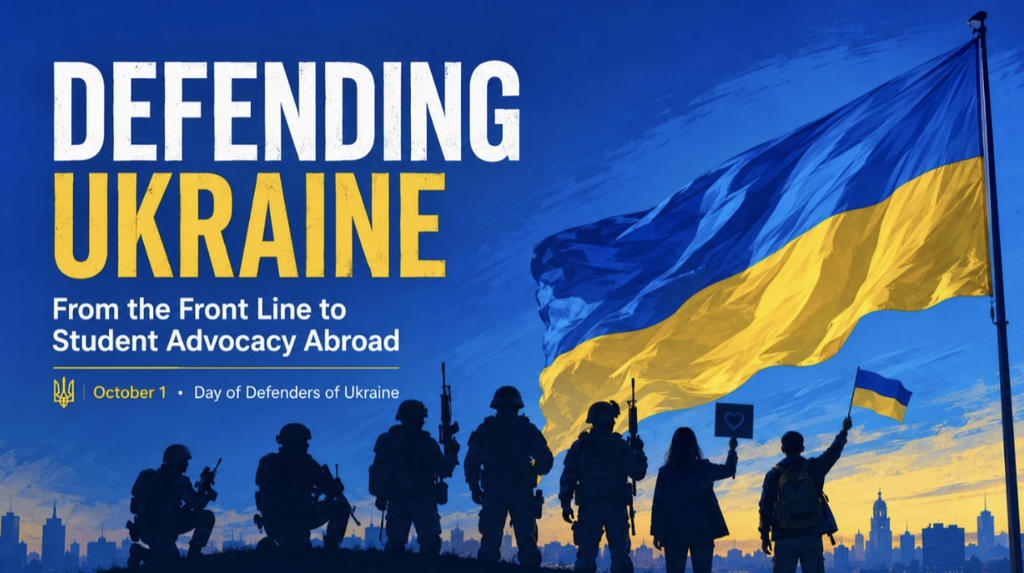
October 1 is the Day of Defenders and Defendresses of Ukraine, which honours those
who protect Ukraine’s sovereignty, territorial integrity, freedom, people, and future. In
2023, Ukraine officially changed the commemoration from October 14 to October 1 as
part of the national calendar transformation (“Official holiday: День захисників і
захисниць України” , 2023). Although the day centres on and highlights those serving
in Ukraine’s defence and security forces, who protect Ukraine from Russian aggression,
it also recognizes veterans, combat medics, volunteers, advocacy groups, rescuers,
military families, and communities whose work sustains the country during war. For
Ukrainian students in Canada, defending Ukraine and its culture on campuses and in
communities is still very important.
Besides that, the defence extends beyond military service. Thus, in his October 1, 2025,
address, President Volodymyr Zelenskyy named the Armed Forces, National Guard,
intelligence services, Security Service, border guards, National Police, communications
units, and State Emergency Service as interconnected components of Ukraine’s
defence. He also reported that more than 1,600 Ukrainians had received state honours
around that year’s commemoration and that nearly 124,000 people had been decorated
for defending Ukraine since the beginning of the full-scale invasion (“Address by the
President on the Day of Defenders of Ukraine”, 2025).
Defence is also a key priority of SUSK, which is deeply connected with its traditions.
Advocacy especially, is SUSK’s responsibility for Ukraine’s struggle abroad. The
Ukrainian Canadian Students’ Union identifies itself as a national organization that
represents Ukrainian Canadian students, provides a forum and diverse assistance for
their concerns, and coordinates Ukrainian Student Organizations across Canada (“Our
Mission,” n.d.). It is also vital because it raises awareness, influences policymakers at
different level, unites communities, and strengthens international solidarity (“Ukrainian
Student Advocacy”, n.d.). During Russia’s continuing war against Ukraine, this opens an
extra battlefront.
Advocacy is becoming a significant part of SUSK’s work, including when regularly
working with universities and colleges across Canada. A vivid example of this comes
from communication with the largest higher education institution in Canada. On March
27, 2026, SUSK issued a public statement after domestic tuition support for some
Ukrainian students at the University of Toronto was withdrawn. SUSK warned that the
decision could create a damaging precedent for other Canadian universities and stated
that it was advocating at both the provincial and federal levels for continued access to
domestic tuition rates. The organization also prepared a letter template and provided
students and community members with direct contact information for the university’s
registrar offices (“Official SUSK Statement”, 2026).
At the same time, SUSK undertook the extensive task of compiling an institution-by-
institution overview of tuition policies and financial support available to Ukrainian
students across Canada. The resource allows students to compare tuition rates at
different post-secondary institutions and highlights some of the most accessible options
(Link will be here). This required substantial research and coordination, but it
transformed advocacy into practical assistance by helping Ukrainian students and their
families make informed educational and financial decisions. Together, these initiatives
demonstrate that SUSK provides concrete tools, identifies viable study options, and
addresses policies that can determine whether displaced Ukrainian students are able to
begin or continue their education in Canada.
SUSK’s work with Ukrainian political prisoners provides another example of advocacy
as defence. In October 2025, SUSK joined the Advocacy Mentorship Initiative for
Crimean Political Prisoners, launched by Ukraine’s Ministry of Foreign Affairs with
support from the Crimea Platform (“SUSK Has Joined the Advocacy Mentorship
Initiative”, 2025). SUSK became an advocate for three young Ukrainian citizens
imprisoned by Russia: Andrii Kuliievych, Kurtamet Appaz, and Abdulmedzhyt
Seitumerov. Kuliievych was sentenced to seven and a half years after distributing anti-
government leaflets in occupied Sevastopol. Appaz, a Crimean Tatar who worked in
information technology, volunteered in Kyiv, and promoted the Crimean Tatar language,
received a seven-year sentence. Seitumerov, a Crimean Tatar activist and father,
remains imprisoned in Rostov-on-Don. SUSK committed to telling their stories in
Canada and amplifying demands for their freedom and for fairness (“SUSK Joins
Advocacy Mentorship Initiative”, 2025).
This example demonstrates why student advocacy matters. A political prisoner held
thousands of kilometres away cannot address a Canadian campus, meet with an
elected official, or correct misinformation circulating online. Students abroad can help
carry that person’s name and story into public spaces. Such actions can save people’s
lives.
In this context, organizing a Ukrainian-language event, a Holodomor commemoration,
or a discussion about Crimea and Donbas is another possibility to advocate and defend
the Ukrainian people. Such activities directly challenge Russia’s attempts to erase
Ukrainian history, language and identity. They also give Canadian students reliable
information that they may not encounter in their courses, news feeds, or everyday
conversations.
Cultural front is important for Ukrainians around the world because every day the
aggressor country tries to destroy or discriminate against rich Ukrainian culture. Based
on a 2024 United Nations report, we know that Russian occupying authorities imposed
Russian laws, institutions, language, and school curricula in occupied territories (which
constitute almost a quarter of the Ukrainian territory). Ukrainian books and cultural
symbols were removed, while teachers were pressured to present Ukrainophobia
narratives that justified Russia’s invasion (“Human Rights Situation”, 2024). We should
also remember that this assault on Ukrainian identity is not limited to propaganda.
Russia’s attacks physically endanger churches, museums, libraries, monuments, and
other cultural landmarks in regions across Ukraine. The June strike on the Kyiv-
Pechersk Lavra, one of Ukraine’s most important spiritual and historical sites, about
which a detailed article was written on the SUSK website (link), demonstrated that even
internationally protected heritage in the capital is not safe. As discussed in our article,
attacks on such places target more than buildings: they threaten the historical memory,
faith, and culture that connect generations of Ukrainians across the world (“UNESCO
Statement on Ukraine”, 2026).
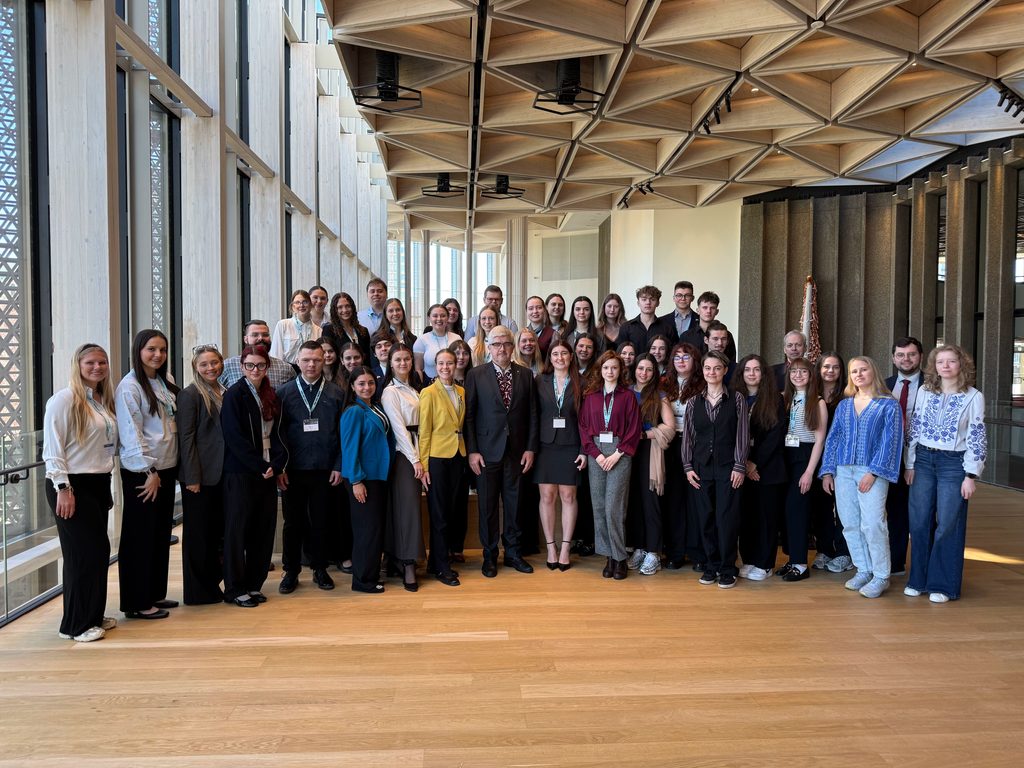
Another part of the importance of October 1 is the memory of those who are no longer
with us, those who were killed by the aggressive actions of the Russian military. The
Unissued Diplomas exhibition demonstrates how students can turn remembrance into
international action. Created in 2023 by more than 50 young Ukrainians in cooperation
with SUSK, the project presented the stories of 40 Ukrainian students whose lives were
taken by Russia’s invasion. The exhibition was displayed at more than 45 universities
worldwide. Instead of presenting the victims only as statistics, each symbolic diploma
represented a real student who should have completed an education, built a career,
made a societal contribution, and lived a full life (“Unissued Diplomas”, 2023).
Advocacy can also be presented as part of the local USO activities. Ukrainian Student
Organizations across Canada bring advocacy directly to Canadian campuses and
Canadian people. They organize events, engage university leaders and student media,
support newly arrived Ukrainians, and turn awareness into practical action. Students
can join or contact their local USO, create new initiatives, volunteer, share reliable
information, and unite Ukrainians and allies around a common purpose. Every action
matters!
By coordinating more than 20 student organizations across Canada, SUSK connects
these local efforts into a national voice. Donations to trusted Ukrainian and
Ukrainian-Canadian organizations are another meaningful form of support: they assist
Ukraine directly while strengthening the institutions, culture, education, and advocacy of
the Ukrainian diaspora in Canada. October 1 should remind us that defence takes many
forms. Students abroad cannot replace those on the front line, but they can defend
Ukraine’s truth, preserve memory, support displaced Ukrainians, and strengthen
communities.
REFERENCES
Address by the President on the Day of Defenders of Ukraine. (2025, October 1). Office
of the President of Ukraine. Retrieved from
https://www.president.gov.ua/en/news/zvernennya-prezidenta-z-nagodi-dnya-zahisnikiv-
i-zahisnic-uk-100473
Human rights situation during the Russian occupation of territory of Ukraine and its
aftermath, 24 February 2022 to 31 December 2023. (2024, March 20). Office of the
United Nations High Commissioner for Human Rights. Retrieved from
https://ukraine.ohchr.org/en/human-rights-situation-during-russian-occupation-territory-
ukraine-and-its-aftermath-EN
Important information. (n.d.). Ukrainian Canadian Students’ Union. Retrieved July 24,
2026, from https://www.susk.ca/important-information/
Official holiday: День захисників і захисниць України [Day of Defenders and
Defendresses of Ukraine]. (2023). Verkhovna Rada of Ukraine. Retrieved from
https://zakon.rada.gov.ua/laws/main/en-it/day193
Official SUSK statement on the withdrawal of domestic tuition support for Ukrainians at
the University of Toronto. (2026, March 27). Ukrainian Canadian Students’ Union.
Retrieved from https://www.susk.ca/official-susk-statement-on-the-withdrawal-of-
domestic-tuition-support-for-ukrainians-at-the-university-of-toronto/
Our mission. (n.d.). Ukrainian Canadian Students’ Union. Retrieved July 24, 2026, from
https://www.susk.ca/about/our-mission/
SUSK has joined the Advocacy Mentorship Initiative for Crimean political prisoners.
(2025, October 7). Crimea Platform. Retrieved from https://crimea-
platform.org/en/news/susk-pryiednalasia-do-initsiatyvy-advokatsiynoho-nastavnytstva-
dlia-krymskykh-politychnykh-v-iazniv/
Ukrainian student advocacy. (n.d.). Ukrainian Canadian Students’ Union. Retrieved July
24, 2026, from https://www.susk.ca/ukrainian-student-advocacy/\
UNESCO statement on Ukraine. (2026, June 17). UNESCO. Retrieved from
https://www.unesco.org/en/articles/unesco-statement-ukraine
Unissued Diplomas. (n.d.). Ukrainian Canadian Students’ Union. Retrieved July 24,
2026, from https://www.susk.ca/unissued-diplomas/