

Written by Daniil Zhelezniak – SMU, Halifax, NS
Every June 28, Ukraine celebrates Constitution Day, a legal anniversary, but also a reminder that Ukraine is a sovereign European nation with its own history, democratic traditions, laws, language, culture, and right to determine its future. In 2026, as Russia’s violence against Ukraine continues, the Constitution of Ukraine carries even deeper meaning. It is not only a document of statehood that regulates the system, but it is a declaration that Ukrainian independence, territorial integrity, democratic identity, and aspirations for European integration cannot be erased by Russian invasion.
Brief History
The Constitution of Ukraine was adopted by the Verkhovna Rada (the parliament of Ukraine) on June 28, 1996, where 315 deputies voted in favour of the Basic Law, exceeding the required minimum of 300 votes (Liashenko, 2023). In particular, the Article 161 of the Constitution made the day of its adoption a national holiday and symbol of Ukraine’s long struggle for lawful statehood, known as Constitution Day of Ukraine (“The Constitution of Ukraine”, 1996, art. 161).
However, it is important to mention that the Ukrainian constitutional history did not begin in 1996, Ukraine has deep constitutional traditions reaching back centuries, always associated with the struggle for democracy and freedom. So, for example, the Constitution of Bendery (named after a city in Moldova), adopted in 1710 by Pylyp Orlyk and the Cossack leadership in exile, as the first constitutional document in Ukrainian history (Kopytko & Bashchenko, 2025). The Bendery Constitution limited the power of the hetman (leader) and envisioned a Cossack council making it one of the most important political documents of early modern Ukrainian state-building and of the most fundamental documents for the development of democracy in the world. For readers interested in this longer tradition, SUSK’s earlier article on Pylyp Orlyk’s Constitution offers a valuable companion piece and helps show that Ukraine’s constitutional culture is much older than the modern state.

Ukraine: a state governed by the rule of law
The Constitution begins with a powerful and not abstract idea, for which the Ukrainian people began to fight in 2014 and continued in 2022: Ukraine is a “sovereign and independent, democratic, and rule-of-law state” (“The Constitution of Ukraine”, 1996, art. 1). This may contrast with the characteristic features of authoritarianism in some of Ukraine’s neighbors and also directly reject the Russian propaganda myth that Ukraine is something dependent, artificial or subordinate to Moscow. Besides that, Article 2 states that Ukraine’s sovereignty extends to its entire territory and that Ukraine’s current borders are indivisible and inviolable, and include 24 regions and the Autonomous Republic of Crimea (“The Constitution of Ukraine”, 1996). Thus, the main document of Ukraine rejects even possible thoughts about recognizing any Ukrainian territories under the occupier and aggressor.
This principle is also in accordance with the UN Charter, which prohibits the use of force against the territorial integrity or political independence of any state, which the Kremlin violated not only against Ukraine, but also, for example, against Georgia (“Chapter I: Article 2(1)-(5) – Charter of the United Nations”, n.d.). Therefore, every Russian attack on Ukrainian lands or any other is a direct and encroachment on the constitutional and international legal order that creates global chaos.
In addition, the Constitution also defines the Ukrainian people as the bearer of sovereignty and the sole source of power in Ukraine (“The Constitution of Ukraine”, 1996, art. 5). This is especially important because Ukrainians have repeatedly defended their right to choose their future independently through the mechanisms of democracy, which fully complies with the norms of the European Union, of which Ukraine wants to see itself as a part. Thus, about 84 percent of eligible voters participated in the 1991 independence referendum, and about 90 percent supported independence, including in Crimea and Donbas (Potichnyj, 1991).
Why is this important for the identity of Ukrainians abroad?
The modern Constitution also requires the state to promote the development of the Ukrainian nation, its historical consciousness, traditions, and culture, while also supporting the ethnic, cultural, linguistic, and religious identity of national minorities (“The Constitution of Ukraine”, 1996, art. 11). This matters deeply during Russia’s war against Ukraine, because Russian attacks are aimed not only at territory, but also at Ukrainian language, history, memory, and cultural heritage. For the Ukrainian diaspora, including Ukrainian Canadian Youth, this is also a reminder that preserving language, culture, and historical memory abroad is part of the broader defence of Ukraine. Only by preserving this after generations, including immigration, after so many trials in the share of the Ukrainian people, will we be able to become truly invincible and indestructible. As Article 12 highlights: Ukraine commits to meeting the national, cultural, and linguistic needs of Ukrainians living beyond the borders of the state (“The Constitution of Ukraine”, 1996, art. 12).
Ukraine’s path
Constitution Day also reminds us that Ukraine’s European and Euro-Atlantic path is now part of its constitutional identity. In 2019, the Verkhovna Rada approved constitutional amendments reflecting Ukraine’s strategic goal of membership in the European Union and NATO; with the amendment passed by 334 votes to 17 (Olearchyk, 2019). The Constitution now identifies the President of Ukraine as the guarantor of the state’s strategic goal and course toward full membership in the European Union and the North Atlantic Treaty Organization (“The Constitution of Ukraine”, 1996, art. 102).
This constitutional choice has already become part of Ukraine’s practical path toward Europe. The European Council decided to open accession negotiations with Ukraine in December 2023 (Nieczypor & Szpala, 2023). In its 2025 Enlargement Package, the European Commission reported that Ukraine had met conditions to open several negotiation clusters and noted Ukraine’s objective to close accession negotiations by the end of 2028 (“2025 Enlargement Package shows progress towards EU membership for key enlargement partners”, 2025). For Ukraine, European integration means continuing reforms that strengthen the rule of law, judicial independence, anti-corruption institutions, media freedom, democratic checks and balances, human rights, and transparent public administration. These reforms can be considered technical tools for building a successful, more prosperous Ukraine that would join the European Union.
The Constitution of Ukraine and its implementation are not perfect, and Ukraine’s democratic institutions need to continue to develop under extremely difficult and unusual conditions. But the survival of the rule of law and constitutional government in Ukraine during Russia’s full-scale invasion is itself a form of national resistance. The Verkhovna Rada continues to function, civil society continues to advocate, journalists continue to report freely, and state institutions continue to work according to the regulations of the Constitution to support the nation’s freedom. Ukraine’s Constitution connects the clear direction: toward Europe, dignity, democracy, security, and a brighter and more prosperous future for the Ukrainian people. It vividly contrasts with the dark legacy of Soviet authoritarianism, poverty, censorship, imperial dependence in the past, and Russia’s attempts to push Ukraine toward fear, unfreedom, and Putin’s autocracy in the present.
REFERENCES
2025 Enlargement Package shows progress towards EU membership for key enlargement partners. (2025, November 4). European Commission. Retrieved from https://www.eeas.europa.eu/delegations/ukraine/2025-enlargement-package-shows-progress-towards-eu-membership-key-enlargement-partners_en?s=232
Chapter I: Article 2(1)-(5) – Charter of the United Nations. (n.d.). United Nations. Retrieved from https://legal.un.org/repertory/art2.shtml
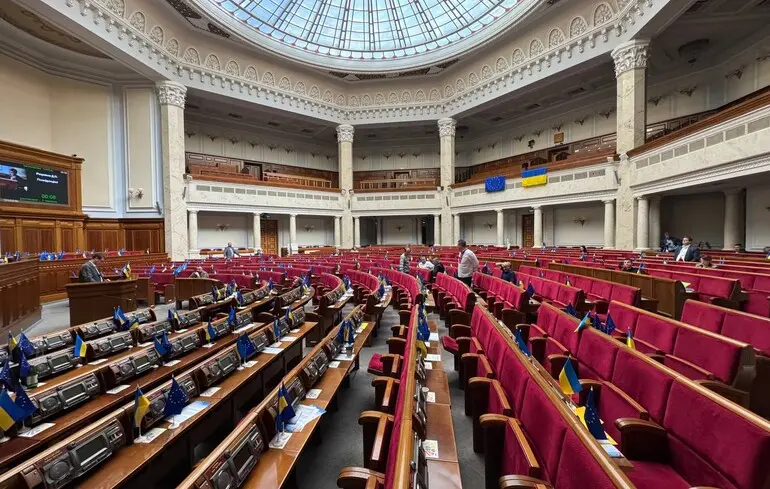
Photo: Chernenko, V. (2026, March 24). The Verkhovna Rada of Ukraine is not holding sessions: Which key bills and resolutions remain unconsidered. reNews. https://renews.com.ua/politika/verhovna-rada-ykrayini-ne-provodit-zasidan-iaki-kluchovi-zakonoproyekti-ta-postanovi-zalishautsia-bez-rozgliady/
Constitution of Ukraine. (1996). Verkhovna Rada of Ukraine. Retrieved from https://zakon.rada.gov.ua/laws/show/en/254%D0%BA/96-%D0%B2%D1%80#Text
Kopytko, V., & Bashchenko, O. (2025, June 28). Ukraine’s first constitution isn’t even in Ukraine – historian Oleksandr Alfiorov. RBC‑Ukraine. Retrieved July 17, 2025, from https://newsukraine.rbc.ua/interview/ukraine-s-first-constitution-isn-t-even-in-1751102581.html
Liashenko, O. (2023, June 28). June 28 – Ukraine Constitution Day. U.S.-Ukraine Foundation. Retrieved from https://usukraine.org/blog/june-28-ukraine-constitution-day
Nieczypor, K., & Szpala, M. (2023, December 15). The EU opens accession talks with Ukraine and Moldova. Centre for Eastern Studies (OSW). Retrieved from https://www.osw.waw.pl/en/publikacje/analyses/2023-12-15/eu-opens-accession-talks-ukraine-and-moldova
Olearchyk, R. (2019, February 7). Ukrainian parliament paves way for EU-Nato membership bid. Financial Times. Retrieved from https://www.ft.com/content/d8857d16-2ac6-11e9-88a4-c32129756dd8?syn-25a6b1a6=1
Potichnyj, P. J. (1991). The Referendum and Presidential Elections in Ukraine. Canadian Slavonic Papers / Revue Canadienne Des Slavistes, 33(2), 123-138. http://www.jstor.org/stable/40869291